
You deserve better service, real commitment, and genuine care.
Estimated Time: 10–15 Minutes
Skill Level: Beginner
Welcome to Lesson 1
Welcome to the Help465 Medicare Academy.
If Medicare seems confusing, you’re not alone.
Many people approaching age 65 feel overwhelmed by advertisements, mailers, television commercials, and conflicting advice from friends and family. Before long, it can seem like everyone has an opinion about what you should do.
Our approach is different.
We’re not here to rush you into a decision.
We’re here to help you understand Medicare first.
By the end of this lesson, you’ll understand what Medicare is, who qualifies, how it’s organized, and what your next steps may be.
Let’s begin.


Lesson Objectives
By the end of this lesson, you will be able to:
✔ Understand what Medicare is.
✔ Know who is generally eligible.
✔ Identify the four parts of Medicare.
✔ Understand what happens when you turn 65.
✔ Know the next step in your Medicare journey.
What Is Medicare?
Medicare is a federal health insurance program.
It was created to help provide health coverage primarily for:
For many people, Medicare begins a new chapter of healthcare coverage.
Understanding how it works before enrolling can make the process much less stressful.
Medicare Minute
You don’t have to become a Medicare expert overnight.
The goal is simply to understand enough to make informed decisions when the time comes.
Meet the Four Parts of Medicare
One reason Medicare seems complicated is because people hear about “Part A,” “Part B,” “Part C,” and “Part D.”
Let’s simplify that.
Part A
Think of Part A as your hospital coverage.
It generally helps pay for:
Part B
Think of Part B as your medical coverage.
It generally helps cover:
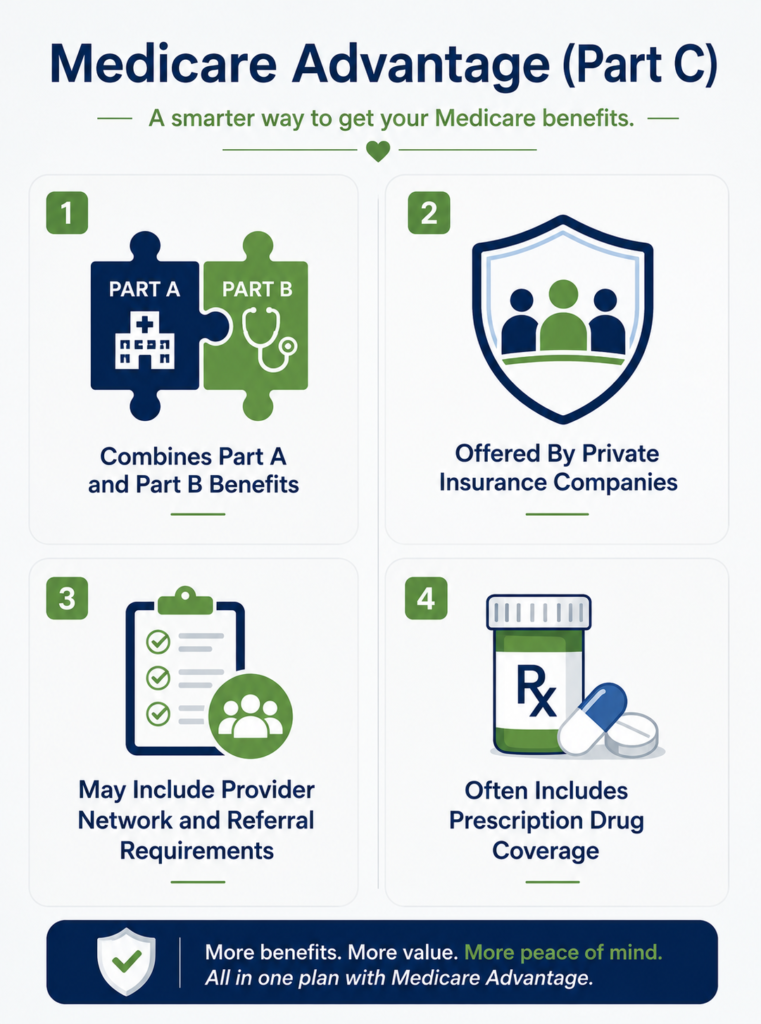
Part C
Part C is also called Medicare Advantage.
Instead of receiving your Medicare-covered benefits directly through Original Medicare, you receive them through a private insurance company approved by Medicare.
Many plans combine hospital, medical, and prescription drug coverage into one plan and may include additional benefits.
We’ll cover this in much greater detail during Lesson 2.
Part D
Part D helps cover prescription medications.
Coverage varies depending on the plan you choose.
We’ll explore prescription drug coverage in a future lesson.

Help465 Heads-Up ⚠️
Don’t assume your friend’s Medicare experience will be the same as yours.
Medicare decisions are personal, and the right path depends on your own healthcare needs, employment, and coverage.
Why Planning Ahead Matters
One of the best things you can do is begin learning before you’re required to make decisions.
When you understand Medicare ahead of time, you’ll have more confidence to:
Knowledge removes uncertainty.
Myth vs. Fact
Myth: Medicare is too complicated for most people to understand.
Fact: Medicare becomes much easier when it’s explained one step at a time.
That’s exactly why this Academy exists.
Helpful Medicare Terms
Original Medicare — Medicare Part A and Part B provided by the federal government.
Medicare Advantage — A private health plan approved by Medicare that provides your Medicare-covered benefits.
Prescription Drug Plan (Part D) — Coverage that helps pay for many outpatient prescription medications.
Enrollment — The process of signing up for Medicare coverage.
Quick Knowledge Check
Let’s see what you’ve learned.
☐ Everyone over age 50
☐ People age 65 and older, along with certain younger individuals who qualify
☐ Anyone with private health insurance
Answer: People age 65 and older, along with certain younger individuals who qualify.
☐ Part A
☐ Part B
☐ Part D
Answer: Part A.
☐ Part B
☐ Part C
☐ Part D
Answer: Part D.

Congratulations!
You’ve completed Lesson 1.
Today you learned:
✅ What Medicare is.
✅ Who generally qualifies.
✅ The four parts of Medicare.
✅ Why turning 65 is an important milestone.
✅ Why learning before enrolling leads to better decisions.
Before You Continue
Take a moment to think about these questions:
Don’t worry if you don’t know all the answers yet.
We’ll build on these questions throughout the Academy.
Continue to Lesson 2
Medicare Advantage vs. Medicare Supplement
Now that you understand the foundation of Medicare, it’s time to learn about one of the biggest decisions most people make:
How do you want to receive your Medicare benefits?
In Lesson 2, we’ll compare Medicare Advantage and Medicare Supplement plans, explain how they work, and help you understand the questions you should ask before choosing either option.
Remember…
You don’t have to memorize Medicare.
You only need to understand it well enough to make confident decisions.
That’s why we’re here.
Next Lesson
Lesson 2: Medicare Advantage vs. Medicare Supplement

Estimated Time: 12–15 Minutes
Skill Level: Beginner–Intermediate
Welcome Back
Congratulations on completing Lesson 1.
Now that you understand the basics of Medicare, it’s time to explore one of the biggest decisions most people face.
How do you want to receive your Medicare benefits?
Many people assume there’s one “best” answer.
There isn’t.
The right Medicare choice depends on your healthcare needs, your doctors, your prescriptions, your lifestyle, and your personal preferences.
Today’s lesson will help you understand your options so you can compare them with confidence.
Lesson Objectives
By the end of this lesson, you’ll be able to:
✔ Explain the difference between Medicare Advantage and Medicare Supplement.
✔ Understand how each option works.
✔ Recognize the advantages and tradeoffs of each approach.
✔ Identify the questions you should ask before making a decision.

Two Different Paths
One of the easiest ways to understand Medicare is to think of it as two different roads leading to the same destination.
Both roads provide Medicare-covered benefits.
They simply take different routes.
Path One
Original Medicare
Path Two
Medicare Advantage
Many Medicare Advantage plans combine hospital, medical, and prescription drug coverage into one plan.
Some also include additional benefits like dental, vision, hearing, and fitness memberships.
Neither road is automatically better.
The goal is choosing the one that fits your journey.
Medicare Minute
The best Medicare plan isn’t the one your neighbor chose.
It’s the one that best supports your healthcare needs.
Original Medicare + Medicare Supplement
Some people prefer Original Medicare because it generally offers broad provider flexibility.
Many beneficiaries also purchase a Medicare Supplement plan to help pay certain out-of-pocket costs that Original Medicare doesn’t fully cover.
Because Medicare Supplement plans usually don’t include prescription drug coverage, many people also enroll in a separate Medicare Part D Prescription Drug Plan.
This approach is often attractive to people who value flexibility and predictable healthcare costs.
Medicare Advantage
Medicare Advantage plans are offered by private insurance companies approved by Medicare.
Instead of receiving your Medicare-covered benefits directly through Original Medicare, you receive them through the Medicare Advantage plan.
Many plans combine several benefits into one package and may include:
Benefits vary depending on the plan and where you live.


Comparing the Two
Provider Choice
If keeping your current doctors is important, checking provider participation should be one of your first steps.
Many Medicare Advantage plans use provider networks.
Medicare Supplement plans generally allow you to receive care from providers nationwide who accept Medicare.
Monthly Costs
Many Medicare Advantage plans have low or even $0 monthly plan premiums (although you generally continue paying your Medicare Part B premium).
Medicare Supplement plans usually have higher monthly premiums.
However, comparing monthly premiums alone rarely tells the whole story.
Healthcare Costs
Many Medicare Advantage plans involve copayments or coinsurance when you receive care.
Medicare Supplement plans are designed to help reduce many Medicare cost-sharing expenses, creating greater predictability for many beneficiaries.
Extra Benefits
Many Medicare Advantage plans include routine dental, vision, hearing, and fitness benefits.
Medicare Supplement plans generally focus on helping pay Medicare cost-sharing rather than providing routine extra benefits.
Help465 Heads-Up ⚠️
Choosing a Medicare plan based only on dental benefits or television advertisements can cause people to overlook much more important considerations like doctors, prescriptions, provider access, and total healthcare costs.
Which Option Might Fit Your Lifestyle?
Medicare Advantage may appeal to you if:
✔ You like having many benefits combined into one plan.
✔ You’re comfortable using a provider network.
✔ Additional benefits such as dental and vision are important to you.
✔ You appreciate having an annual maximum out-of-pocket limit for covered medical expenses.
Medicare Supplement may appeal to you if:
✔ You value provider flexibility.
✔ You travel frequently.
✔ You prefer more predictable healthcare costs.
✔ You’re comfortable purchasing a separate Prescription Drug Plan.
These aren’t rules.
They’re simply considerations that can help guide your thinking.

Myth: Medicare Advantage is always better because it includes more benefits.
Fact: Extra benefits can be valuable, but they’re only one part of the decision.
Your doctors, prescriptions, expected healthcare needs, travel habits, and overall costs often matter even more.
Original Medicare — Medicare Part A and Part B provided by the federal government.
Medicare Advantage — A private Medicare-approved health plan that provides your Medicare-covered benefits.
Medicare Supplement (Medigap) — Private insurance that helps pay certain out-of-pocket costs associated with Original Medicare.
Network — The group of doctors, hospitals, and healthcare providers contracted with a particular health plan.
1. True or False?
Medicare Advantage and Medicare Supplement are the same thing.
Answer: False.
2. Which option generally works alongside Original Medicare?
☐ Medicare Supplement
☐ Medicare Advantage
Answer: Medicare Supplement.
3. Which option often includes prescription drug coverage?
☐ Many Medicare Advantage plans
☐ All Medicare Supplement plans
Answer: Many Medicare Advantage plans.
Reflection
Take a moment to think about your own healthcare.
There are no right or wrong answers.
Ask yourself:
Write your answers down.
We’ll continue building on them throughout the Academy.
What You Learned
Today you learned:
✅ The two primary ways people receive Medicare benefits.
✅ How Medicare Advantage works.
✅ How Medicare Supplement works.
✅ The major differences between the two.
✅ How to begin comparing your own priorities.
Continue to Lesson 3
Seven Medicare Mistakes That Could Cost You Money
Now that you understand your Medicare choices, it’s time to learn how to avoid some of the most common mistakes people make before enrolling.
A few minutes of preparation today can save significant time, money, and frustration later.
Remember…
The goal isn’t choosing the “best” Medicare plan.
The goal is choosing the plan that’s best for you.
That’s the difference between selling Medicare…
…and understanding Medicare.

Estimated Time: 10–12 Minutes
Skill Level: Beginner
Welcome Back
You’ve already learned what Medicare is and explored the two primary ways people receive their Medicare benefits.
Now let’s talk about something just as important.
The mistakes.
Every year, people make Medicare decisions they later wish they had approached differently…not because they weren’t intelligent, but because Medicare can be confusing and they’re often asked to make important decisions before they fully understand their options.
The encouraging news is that many of these mistakes are preventable.
Today’s lesson is designed to help you recognize them before they happen.

Mistake #1
Waiting Until the Last Minute
Many people begin learning about Medicare only a few weeks before their 65th birthday.
By then, they may feel rushed by deadlines, advertisements, and information overload.
A Better Approach
Start learning several months before you’re eligible.
Giving yourself time to understand your options often leads to better decisions.
Real-Life Scenario
Maria turns 65 in three months.
Instead of waiting until the last minute, she spends a little time each week learning about Medicare. By the time she’s ready to enroll, she understands the basics and feels much more confident.
Lesson: Knowledge reduces stress.
Medicare Minute
One of the greatest advantages you can give yourself isn’t choosing a plan early.
It’s learning early.
Mistake #2
Assuming Enrollment Happens Automatically
Not everyone is automatically enrolled in Medicare.
Some people are.
Others need to enroll themselves.
Knowing which situation applies to you is important before your enrollment period ends.
Mistake #3
Choosing a Plan Before Checking Your Doctors
Your relationship with your healthcare providers matters.
A plan that looks attractive on television may not include your preferred doctors or hospitals.
A Better Approach
Before making a decision, verify:
Help465 Heads-Up ⚠️
Always confirm provider participation before enrolling.
Don’t rely on assumptions or outdated information.


Mistake #4
Forgetting About Prescription Medications
Prescription drug coverage varies from plan to plan.
Even when two plans appear similar, the way they cover your medications may be very different.
A Better Approach
Create a complete medication list before comparing plans.
Include:
Mistake #5
Comparing Only Monthly Premiums
Monthly premiums are important.
But they’re only one piece of the puzzle.
Healthcare costs may also include:
A Better Approach
Compare your expected total healthcare costs…not simply your monthly premium.
Mistake #6
Never Reviewing Your Coverage Again
Healthcare changes.
Prescription medications change.
Doctors change.
Medicare plans change.
That’s why reviewing your coverage every year is an important habit.
Reviewing doesn’t mean changing.
It simply means confirming your current plan still fits your needs.
Mistake #7
Letting Advertisements Make the Decision
Television commercials can introduce Medicare options.
They cannot evaluate your healthcare needs.
Only you can decide which Medicare coverage best supports your doctors, prescriptions, healthcare priorities, and budget.
Advertisements are a starting point…not the finish line.
Myth vs. Fact
Myth: The Medicare plan with the most advertised benefits is automatically the best choice.
Fact: The best plan is the one that fits your individual healthcare needs…not the one with the most commercials.

Provider Network — The doctors, hospitals, and healthcare providers that participate with a health plan.
Formulary — A plan’s list of covered prescription medications.
Annual Review — Reviewing your Medicare coverage each year to make sure it still fits your healthcare needs.
1. True or False?
The lowest monthly premium always means the lowest healthcare costs.
Answer: False.
2. Why is it important to review your medications before choosing a plan?
☐ Because every plan covers medications exactly the same.
☐ Because prescription drug coverage can vary by plan.
Answer: Prescription drug coverage can vary by plan.
3. Should television advertisements be your only source of Medicare information?
☐ Yes
☐ No
Answer: No.
Think about your own situation.
Which of today’s seven mistakes do you think would be easiest to make?
Which one surprised you the most?
Is there anything you’d like to double-check before making future Medicare decisions?
Remember…
The purpose of learning isn’t perfection.
It’s preparation.
What You Learned
Congratulations!
Today you learned:
✅ Seven common Medicare mistakes.
✅ Why they happen.
✅ How to avoid them.
✅ Why preparation builds confidence.
Before You Move On
Before beginning Lesson 4, make sure you can answer “yes” to these questions:
✓ Do I understand why learning early is important?
✓ Do I know why my doctors and medications matter?
✓ Do I understand that choosing Medicare involves much more than comparing monthly premiums?
If so…
You’re ready for the next lesson.
Continue to Lesson 4
Understanding Medicare Enrollment Periods
Now that you understand your Medicare choices and know how to avoid common mistakes, it’s time to learn when Medicare decisions can be made and how different enrollment periods work.
Timing is an important part of Medicare.
We’ll explain it one step at a time.
Remember…
People rarely regret learning too much before making an important healthcare decision.
They sometimes regret learning too little.
That’s why you’re here.
One lesson at a time.

Estimated Time: 12–15 Minutes
Skill Level: Beginner–Intermediate
Where You Are in the Academy
✅ Lesson 1 — Welcome to Medicare
✅ Lesson 2 — Your Medicare Choices
✅ Lesson 3 — Avoiding Common Medicare Mistakes
📖 Lesson 4 — Understanding Medicare Timing
⬜ Lesson 5 — Understanding Medicare Costs
⬜ Lesson 6 — Putting It All Together
Welcome Back
By now you’ve learned:
Today’s lesson answers another important question:
“When can I actually make Medicare decisions?”
Many people assume they can enroll or change Medicare whenever they choose.
In reality, Medicare has specific enrollment periods designed for different life situations.
Once you understand those situations, Medicare becomes much easier to navigate.

Lesson Objectives
By the end of today’s lesson you’ll be able to:
✔ Understand the most common Medicare enrollment periods.
✔ Recognize which enrollment period may apply to your situation.
✔ Understand why timing matters.
✔ Know when it’s time to ask questions.
Situation 1
“I’m Turning 65.”
For many people, Medicare begins with the Initial Enrollment Period (IEP).
This enrollment opportunity generally lasts seven months.
It begins:
This is often the first opportunity to enroll in Medicare and compare your healthcare options.
Real-Life Scenario
David turns 65 in October.
Instead of waiting until October, he begins learning during the summer.
When his enrollment period arrives, he already understands the basics and can make thoughtful decisions without feeling rushed.
Lesson: Learning early makes enrollment easier.
Help465 Heads-Up ⚠️
Don’t wait until your birthday month to begin learning.
Medicare decisions are much easier when you’ve had time to understand your options.
Situation 2
“I’m Still Working.”
Many people continue working after age 65.
If you’re covered under qualifying employer health insurance…or covered under your spouse’s qualifying employer plan…you may have different Medicare enrollment options.
Whether delaying certain parts of Medicare makes sense depends on your specific circumstances.
That’s why understanding your employment situation is so important before enrolling.
Situation 3
“I’m Retiring.”
Retirement often changes your Medicare timeline.
Many people who delayed Medicare because they had qualifying employer coverage become eligible for a Special Enrollment Period (SEP) after they retire.
This enrollment opportunity helps many eligible individuals transition from employer coverage to Medicare without certain late enrollment penalties.


Medicare Minute
Retirement changes more than your paycheck.
It may also change your Medicare opportunities.
Situation 4
“I Already Have Medicare but Want to Change Plans.”
Healthcare needs change.
Doctors change.
Prescription medications change.
Fortunately, Medicare provides an Annual Enrollment Period (AEP) each year when eligible beneficiaries may review and make certain changes to their Medicare coverage.
Reviewing your coverage doesn’t mean changing your plan.
It simply means confirming your current coverage still fits your needs.
Situation 5
“I’m Already in a Medicare Advantage Plan.”
If you’re currently enrolled in a Medicare Advantage plan, Medicare also provides a Medicare Advantage Open Enrollment Period (MA OEP).
During this time, eligible individuals may generally:
This provides additional flexibility for many beneficiaries.
Situation 6
“I Recently Moved.”
Moving can affect your Medicare coverage.
Depending on your circumstances, relocating may qualify you for a Special Enrollment Period.
Whenever you move, it’s a good idea to review how your Medicare coverage may be affected.
Situation 7
“I Think I Missed My Enrollment Period.”
Don’t panic.
Many people worry they’ve missed their opportunity to enroll.
Depending on your circumstances, you may still have options.
Your next opportunity depends on factors such as:
Every situation is different.
Myth vs. Fact
Myth: Missing one Medicare enrollment deadline means you’re out of options forever.
Fact: Many people still qualify for future enrollment opportunities depending on their circumstances.

Initial Enrollment Period (IEP) — The first Medicare enrollment opportunity for many people turning 65.
Special Enrollment Period (SEP) — An enrollment opportunity created by certain qualifying life events.
Annual Enrollment Period (AEP) — A yearly opportunity for eligible beneficiaries to review and make certain Medicare coverage changes.
Medicare Advantage Open Enrollment Period (MA OEP) — An enrollment opportunity for people already enrolled in a Medicare Advantage plan.
Everyone enrolls in Medicare the same way.
Answer: False.
☐ Initial Enrollment Period
☐ Annual Enrollment Period
☐ Open Enrollment Period
Answer: Initial Enrollment Period.
☐ Yes
☐ No
Answer: Yes.
Think about your own situation.
Which of today’s seven scenarios sounds most like you?
Understanding where you are today makes it much easier to understand which Medicare opportunities may apply to you.
What You Learned
Congratulations!
You’ve now learned:
✅ Why Medicare has different enrollment periods.
✅ Which enrollment periods are most common.
✅ How life events affect Medicare timing.
✅ Why reviewing your coverage each year is important.
Before You Move On
Before beginning Lesson 5, ask yourself:
✓ Do I understand which Medicare timeline most closely matches my situation?
✓ Do I know that different life events can create different enrollment opportunities?
✓ Do I understand why reviewing my coverage each year is important?
If your answer is “yes”…
You’re ready for the next lesson.
Continue to Lesson 5
Understanding Medicare Costs
Now that you understand when Medicare decisions happen, it’s time to understand what Medicare may cost and how premiums, deductibles, copayments, coinsurance, and financial assistance work together.
Understanding Medicare costs is one of the final pieces needed before bringing everything together in Lesson 6.
Remember…
The best Medicare decisions aren’t made in a hurry.
They’re made with good information…
at the right time.

Estimated Time: 12–15 Minutes
Skill Level: Beginner
Where You Are in the Academy
✅ Lesson 1 — Welcome to Medicare
✅ Lesson 2 — Your Medicare Choices
✅ Lesson 3 — Avoiding Common Medicare Mistakes
✅ Lesson 4 — Understanding Medicare Timing
📖 Lesson 5 — Understanding Medicare Costs
⬜ Lesson 6 — Putting It All Together
Welcome Back
By now you’ve learned:
Today’s lesson answers another important question:
“How much will Medicare actually cost?”
Many people believe choosing Medicare simply means finding the lowest monthly premium.
In reality, Medicare costs involve several different pieces working together.
Today’s lesson will help you understand those pieces and how to compare them more confidently.

Why This Lesson Matters
Understanding Medicare costs isn’t about becoming an accountant.
It’s about learning how to compare your options wisely before making an important healthcare decision.
Lesson Objectives
By the end of today’s lesson you’ll be able to:
✔ Explain the most common Medicare costs.
✔ Understand why premiums aren’t the whole story.
✔ Recognize the difference between predictable and unexpected healthcare costs.
✔ Know where financial assistance may be available.
The Five Building Blocks of Medicare Costs
Instead of trying to memorize dozens of numbers, think about Medicare costs as five building blocks.
Your monthly payment for certain Medicare coverage.
Think of it as the cost of keeping your coverage active.
The amount you may pay before certain Medicare coverage begins paying its share.
Fixed dollar amounts you may pay when receiving certain healthcare services.
Your share of the cost of certain covered healthcare services.
Unlike a copayment, coinsurance is generally based on a percentage.
Prescription medications are an important part of many people’s healthcare expenses.
Your costs depend on factors such as:
Medicare Minute
Monthly premiums are easy to compare.
Total healthcare costs are smarter to compare.
Looking at the Whole Picture
Imagine two Medicare plans.
Plan A
Lower monthly premium.
Higher copayments.
Higher healthcare costs when services are used.


Plan B
Higher monthly premium.
Lower out-of-pocket healthcare costs.
More predictable expenses.
Which plan costs less?
The answer depends on how you use healthcare.
That’s why comparing only monthly premiums rarely tells the whole story.
Real-Life Scenario
Susan chooses a plan because it has a very low monthly premium.
A few months later, she begins seeing specialists more often than expected.
Although she saved money each month on premiums, her overall healthcare expenses ended up being higher than she anticipated.
Lesson: Looking at total expected healthcare costs often provides a better picture than comparing premiums alone.
Help465 Heads-Up ⚠️
The least expensive plan isn’t always the least expensive choice.
Always compare your expected healthcare costs over the entire year.
Financial Assistance
Many people don’t realize that Medicare financial assistance programs exist.
Depending on your circumstances, you may qualify for programs that help reduce:
Examples include:
Eligibility depends on individual circumstances, but it’s always worth asking if assistance may be available.
Myth vs. Fact
Myth: Medicare is free.
Fact: While many people qualify for premium-free Part A, Medicare may still involve premiums, deductibles, copayments, coinsurance, prescription drug costs, and other healthcare expenses.
Helpful Medicare Terms
Premium — A monthly payment for certain Medicare coverage.
Deductible — The amount you may pay before certain Medicare coverage begins paying.
Copayment — A fixed amount you may pay for certain healthcare services.
Coinsurance — Your share of covered healthcare costs.
Maximum Out-of-Pocket — The most you generally pay for covered medical services during a plan year under certain Medicare coverage options.

The lowest monthly premium always means the lowest healthcare costs.
Answer: False.
☐ Premium
☐ Copayment
☐ Coinsurance
Answer: Premium.
☐ Yes
☐ No
Answer: Yes.
Think about your own priorities.
Would you rather have:
Neither answer is automatically right or wrong.
Understanding your own preferences helps you compare Medicare options more effectively.
My Healthcare Priorities
Take a few minutes to complete this worksheet.
My Current Doctors
My Current Medications
How Often Do I Visit My Doctor?
Which Matters More To Me?
☐ Lower monthly premiums
☐ More predictable healthcare costs
Questions I Still Have
Keep this worksheet.
You’ll use it in the final lesson.
What You Learned
Congratulations!
You’ve now learned:
✅ The five major Medicare cost categories.
✅ Why monthly premiums don’t tell the whole story.
✅ How to think about total healthcare costs.
✅ That financial assistance programs may be available.
Before You Move On
Before beginning Lesson 6, ask yourself:
✓ Do I understand that Medicare costs involve more than monthly premiums?
✓ Can I explain the difference between premiums, deductibles, copayments, and coinsurance?
✓ Have I started thinking about my own healthcare priorities?
If so…
You’re ready for the final lesson.
Continue to Lesson 6
Putting It All Together
You’ve learned the fundamentals.
Now it’s time to connect everything you’ve learned and prepare to make informed Medicare decisions based on your own unique situation.
One final lesson…
and you’ll graduate from the Help465 Medicare Academy.
Remember…
The goal isn’t to find the cheapest Medicare plan.
The goal is to find the Medicare plan that’s the best fit for your life.

Estimated Time: 15–20 Minutes
Skill Level: Beginner
Where You Are in the Academy
✅ Lesson 1 — Welcome to Medicare
✅ Lesson 2 — Your Medicare Choices
✅ Lesson 3 — Avoiding Common Medicare Mistakes
✅ Lesson 4 — Understanding Medicare Timing
✅ Lesson 5 — Understanding Medicare Costs
🎓 Lesson 6 — Putting It All Together
Welcome to Your Final Lesson
Congratulations.
You’ve made it to the final lesson of the Help465 Medicare Academy.
Take a moment to appreciate how far you’ve come.
When you started Lesson 1, Medicare may have felt confusing, overwhelming, or even intimidating.
Now…
You understand the fundamentals.
You know the different parts of Medicare.
You understand your coverage options.
You recognize common mistakes.
You know why timing matters.
You understand how Medicare costs work.
Today isn’t about learning something new.
It’s about bringing everything together.

Why This Lesson Matters
Making a Medicare decision isn’t about finding the “perfect” plan.
It’s about choosing the coverage that best fits your life.
That’s exactly what this lesson will help you do.
Lesson Objectives
By the end of today’s lesson you’ll be able to:
✔ Organize your Medicare priorities.
✔ Prepare for a Medicare conversation.
✔ Know which questions to ask.
✔ Feel confident making informed decisions.
The Help465 Method™
Throughout the Academy you’ve learned our four-step approach.
Now let’s put it into practice.
Step 1
Learn
Before making any Medicare decision, understand the basics.
Ask questions.
Take your time.
Build your foundation.
You’ve already done this.
Step 2
Compare
Now compare your options based on what matters to you.
Think about:
Not someone else’s.
Yours.
Step 3
Choose
Once you understand your options, choose the Medicare coverage that best fits your individual situation.
Not because of a television commercial.
Not because of a friend.
Not because someone pressured you.
Because you understand why it’s the right fit.

Step 4
Review
Healthcare changes. Plans change. Life changes. Reviewing your Medicare coverage every year helps ensure it continues to meet your needs.
Remember…
Reviewing doesn’t always mean changing. It means staying informed.
Medicare Minute
Confident decisions aren’t made by people who know everything. They’re made by people who understand enough to ask the right questions.
Your Medicare Readiness Checklist
Before enrolling, make sure you’ve completed these steps.
☐ I understand the basics of Medicare.
☐ I know my enrollment timeline.
☐ I’ve compared my Medicare options.
☐ I’ve reviewed my doctors.
☐ I’ve reviewed my prescription medications.
☐ I understand my expected healthcare costs.
☐ I’ve considered my travel habits.
☐ I’ve written down my questions.
☐ I feel comfortable with my decision.
If you couldn’t check every box today…
That’s okay.
The purpose of this checklist is to help you identify what you still need to learn.
Academy Workbook 📝
My Medicare Profile
My Primary Doctors
My Prescription Medications
My Preferred Hospitals
My Healthcare Priorities
☐ Keeping my current doctors
☐ Predictable healthcare costs
☐ Lower monthly premiums
☐ Extra benefits
☐ Prescription drug coverage
☐ Nationwide provider flexibility
☐ Other:
Questions I Still Want Answered
Real-Life Scenario
Robert and Linda both completed the Help465 Medicare Academy.
Before speaking with an agent, they had already:
✔ Listed their medications.
✔ Written down their doctors.
✔ Identified their healthcare priorities.
✔ Learned the differences between Medicare Advantage and Medicare Supplement.
Their Medicare conversation wasn’t rushed.
Instead of asking,
“What should we buy?”
They asked,
“Which option best fits our healthcare needs?”
That small difference completely changed the conversation.

Education creates confidence.
Confidence leads to better questions.
Better questions often lead to better decisions.
No one should ever feel pressured to choose a Medicare plan they don’t understand.
If something isn’t clear…
Ask.
Good guidance welcomes questions.
Myth: You need to understand every Medicare rule before making a decision.
Fact: You don’t need to know everything.
You simply need to understand enough to compare your options confidently and know when to ask questions.
Think back to Lesson 1.
How do you feel now compared to when you first started?
Can you explain Medicare more confidently?
Do you understand your options better?
What questions do you still have?
Learning is a journey.
Today marks the beginning…not the end.
Can you answer “yes” to these questions?
✓ I understand the four parts of Medicare.
✓ I understand the difference between Medicare Advantage and Medicare Supplement.
✓ I know my Medicare timeline.
✓ I understand how Medicare costs work.
✓ I know which questions to ask before enrolling.
✓ I understand that the best Medicare decision depends on my individual situation.
If you answered “yes”…
Congratulations.
Congratulations!
You’ve successfully completed the Help465 Medicare Academy.
That’s an accomplishment.
More importantly…
You’ve taken the time to understand Medicare before making one of your most important healthcare decisions.
That knowledge belongs to you.
No one can take it away.
Whether you enroll next week…
Next month…
Or next year…
You’ll approach Medicare with more confidence than when you first arrived.
Your Next Step
The Academy has given you knowledge.
Now it’s time to apply it.
If you’d like help reviewing your doctors, medications, healthcare priorities, and Medicare options, Help465 is here to guide you.
Not to pressure you.
Not to rush you.
Simply to help you make a decision you’ll feel confident about.
A Personal Message from Mario
Thank you for investing your time in the Help465 Medicare Academy.
I created this Academy because I believe people deserve to understand Medicare before making important healthcare decisions.
Too often, individuals are asked to choose plans before they fully understand their options.
I wanted Help465 to be different.
Whether we ever have the opportunity to work together or not, I hope this Academy has given you greater confidence, clarity, and peace of mind.
Thank you for learning with us.
I wish you the very best on your Medicare journey.
— Mario
Remember…
Education comes before enrollment.
Understanding comes before decisions.
Confidence comes before commitment.
Welcome to Help465.
And congratulations once again.

Whether you’re approaching your 65th birthday, preparing to retire, helping a loved one, or simply trying to understand your Medicare options, welcome.
The Help465 Medicare Academy was created with one simple goal:
To help you understand Medicare before you make one of your most important healthcare decisions.
Unlike many Medicare websites, the Academy isn’t designed to overwhelm you with insurance terminology or pressure you into making a quick decision.
Instead, we’ve organized Medicare into simple, easy-to-follow lessons that build upon one another.
Learn at your own pace.
Ask questions.
Take notes.
Return anytime.
Because we believe…
Education Always Comes Before Enrollment.

How the Academy Works
The Academy is divided into six lessons.
Each lesson builds on the previous one and focuses on a specific part of your Medicare journey.
By the end of the Academy, you’ll understand the foundations of Medicare, the choices available to you, common mistakes to avoid, and how to make confident healthcare decisions.
Lesson 1
Turning 65: Everything You Need to Know Before You Enroll
Estimated Time: 10–15 Minutes
In This Lesson
You’ll learn:
By the End You’ll Know
✓ The basics of Medicare
✓ What steps to take before enrolling
✓ Where to begin your Medicare journey
Lesson 2
Medicare Advantage vs. Medicare Supplement
Estimated Time: 12–15 Minutes
In This Lesson
You’ll learn:
By the End You’ll Know
✓ The two primary ways people receive Medicare benefits
✓ The advantages and tradeoffs of each approach
✓ How to compare your options more confidently
Lesson 3
Seven Medicare Mistakes That Could Cost You Money
Estimated Time: 10 Minutes
In This Lesson
You’ll learn:
By the End You’ll Know
✓ How to avoid common Medicare pitfalls
✓ Why preparation leads to better decisions


Lesson 4
Understanding Medicare Enrollment Periods
Estimated Time: 12 Minutes
In This Lesson
You’ll learn:
By the End You’ll Know
✓ Which enrollment period applies to your situation
✓ How to avoid missing important deadlines
Lesson 5
Understanding Medicare Costs
Estimated Time: 12–15 Minutes
In This Lesson
You’ll learn:
By the End You’ll Know
✓ How Medicare costs work together
✓ Why the lowest premium isn’t always the lowest cost
✓ What financial assistance may be available
Lesson 6
Putting It All Together
Estimated Time: 15 Minutes
Congratulations…you’ve learned the fundamentals of Medicare.
Now it’s time to bring everything together.
In this lesson, you’ll learn how to:
You’ll Complete
Your personal Medicare preparation checklist.
Your medication worksheet.
Your doctor checklist.
Your Medicare questions list.
By the end of this lesson, you’ll be prepared to compare Medicare coverage based on your own healthcare needs…not someone else’s.

Throughout the Academy, you’ll learn our simple four-step approach to understanding Medicare.
Build a strong foundation by understanding how Medicare works before making decisions.
↓
Review your doctors, prescriptions, healthcare needs, budget, and available Medicare options.
↓
Select the Medicare coverage that best fits your individual circumstances and long-term healthcare goals.
↓
Revisit your Medicare coverage each year to ensure it continues to meet your healthcare needs as your life and available plans evolve.
This is the Help465 Method:
Learn. Compare. Choose. Review.
Throughout each lesson you’ll find helpful learning tools designed to make Medicare easier to understand.
Medicare Minute
Quick educational tips that explain important Medicare concepts in under a minute.
Help465 Heads-Up ⚠️
Important reminders about common mistakes and things you should know before making Medicare decisions.
Myth vs. Fact
Helping separate common misconceptions from factual Medicare information.
Helpful Medicare Terms
Simple definitions that explain Medicare terminology in plain English.
Key Takeaways
A quick summary at the end of each lesson highlighting the most important points.
Graduation
Congratulations!
You’ve completed the Help465 Medicare Academy.
You now have a stronger understanding of Medicare than most people do before making enrollment decisions.
Whether you’re enrolling for the first time, reviewing your current coverage, or helping a loved one navigate Medicare, you’ve taken an important step toward making informed healthcare decisions.
Knowledge builds confidence.
Confidence leads to better decisions.
What’s Next?
The Academy teaches Medicare.
The next step is applying what you’ve learned to your own situation.
Every person’s healthcare needs are different.
Your doctors.
Your prescriptions.
Your retirement plans.
Your budget.
Your travel habits.
These all influence which Medicare options may be the best fit for you.
If you’re ready to discuss your personal situation, Help465 is here to help.
No pressure.
No confusing jargon.
Just honest guidance, trusted advice, and genuine care.
Because we believe the best Medicare decisions begin with understanding.
Welcome to Help465.